 Talencap
Step 2 · Prepare a CV that gets interviews
How to write a professional CV that gets interviews
With a few years of experience, the challenge is no longer filling the page, but choosing. Recruiters want to understand your job, your level and what you have achieved within seconds. A good professional CV selects, prioritises and proves.
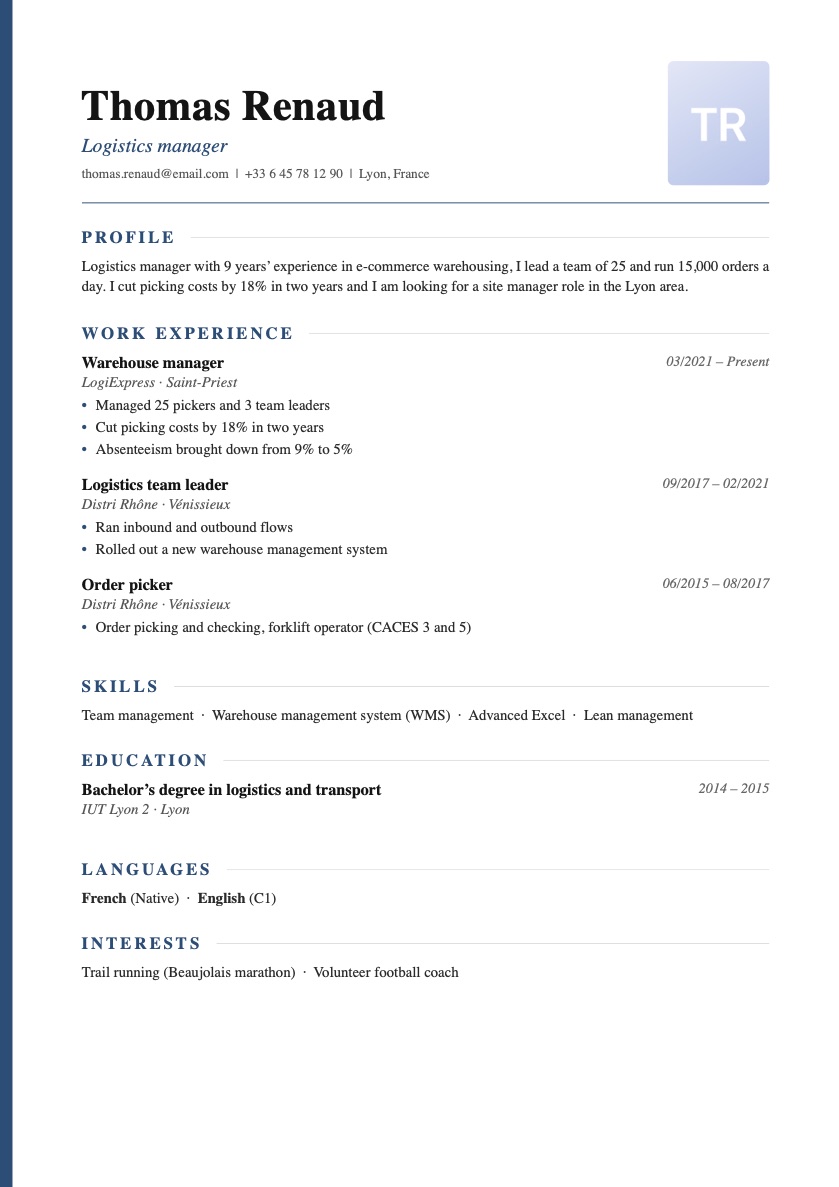
The ideal structure
- Your contact details and the job title you want, right under your name
- A 3-line personal statement: your job, your years of experience, what you bring
- Your experience, most recent first, with 3 to 5 achievements each
- Your key skills: technical, software, soft skills
- Your education, in a few lines
- Your languages and, if they add something, your interests
Describe achievements, not tasks
Recruiters already know what an accountant or a logistics manager does. What they do not know is what you achieved. For each role, turn tasks into results: an action verb, what you did, and the effect, with figures where possible.
- “Stock management” becomes “Cut stock-outs by 18% in one year by revising reorder points”
- “Team management” becomes “Managed 25 pickers; absenteeism brought down from 9% to 5%”
- “Customer relations” becomes “Retained a portfolio of 80 business clients, 95% renewal rate”
One page or two?
One page is enough for up to about ten years of experience. Beyond that, two pages are fine if every line is useful for the role. Beyond two pages, recruiters stop reading.
Talencap templates automatically adjust text size and spacing so your CV fills the page nicely without overflowing.
Detail the last 10 years
Your recent experience matters most. Detail it, then sum up older roles in one line each, or group them under “Earlier experience”. Your CV becomes clearer, and the recruiter focuses on your current level.
Tailor your CV to each job
Use the exact job title in your CV title, rewrite your personal statement, and put the achievements that match the ad first. Using its keywords also helps your CV get through recruitment software.
Explaining a break or a career change
A period out of work is not a deal-breaker; an unexplained gap is. One line is enough: “Parental leave”, “Web developer training (6 months)”, “Business start-up project”. If you are changing career, highlight transferable skills and your training right from your personal statement.
Example personal statement
Logistics manager with 9 years’ experience in e-commerce warehousing, I lead a team of 25 and run 15,000 orders a day. I cut picking costs by 18% in two years and I am looking for a site manager role in the Lyon area.
Mistakes to avoid
- A list of tasks copied from the job description, with no results
- Roles from more than 15 years ago described in as much detail as recent ones
- Unexplained gaps in dates
- A CV of three pages or more
- Outdated software or methods that date your profile
Ready to create your CV?
A guided questionnaire, professional templates and a PDF ready to send. No sign-up: your data stays on your device.
Create my CV now →Frequently asked questions
Should I put my age on my CV?
No, it is not required, and most recruiters no longer expect it. In the UK it is best left out. Your dates of experience and education are enough.
How many jobs should I include on my CV?
Usually 3 to 5 detailed roles, the most recent and most relevant to the job. Older ones can be summed up in one line.
Should a professional CV have a photo?
In France it is optional; in the UK and US, leave it out. If you add one, it should be sharp, recent and professional: our CV photo guide explains how to take one with a smartphone.